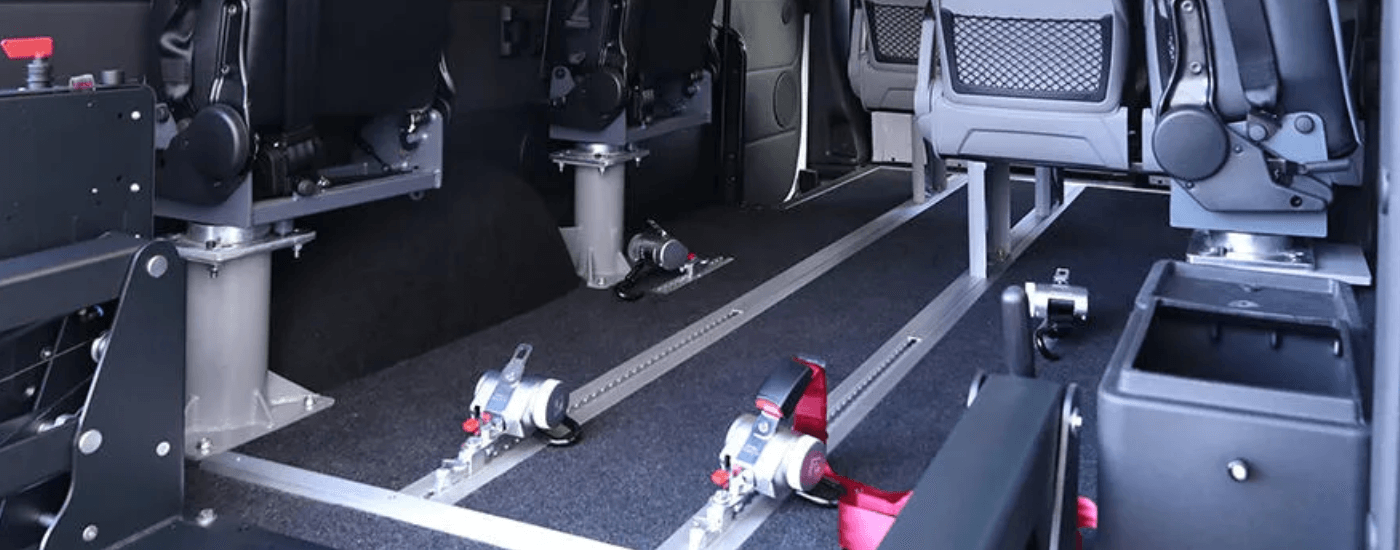
Every wheelchair-accessible vehicle we fit out includes a wheelchair tie-down and occupant restraint system is engineered, installed to New Zealand standards, and tested against real-world use in the vehicles we build. Restraints secure both the wheelchair and its occupant during transit: a tie-down system anchors the wheelchair to the floor, and an occupant restraint holds the person in place, the same way a seatbelt does. Both parts have to be fitted correctly for the system to work.
We fit two main types of tie-down system:
Track-mounted retractor systems — four retractor straps that clip to the wheelchair frame, with anchor points that slide anywhere along a floor-mounted track. That flexibility makes it easy to adjust for different wheelchair sizes and load positions, and it’s straightforward for trained staff to fit.
Docking (monodisc) systems — four retractor straps, each fixed to its own mono point disc set into the floor at a defined position. Loading a wheelchair means pulling the retractor’s release pin, sliding it onto the disc, and releasing the pin to lock it in place — a quick, repeatable action rather than free positioning along a track. Because the anchor points are fixed, staff can load a wheelchair faster once they know the set positions, which suits high-frequency routes such as retirement village transport.
We help you choose the system that suits your fleet, passengers, and operators.


